

Introduction
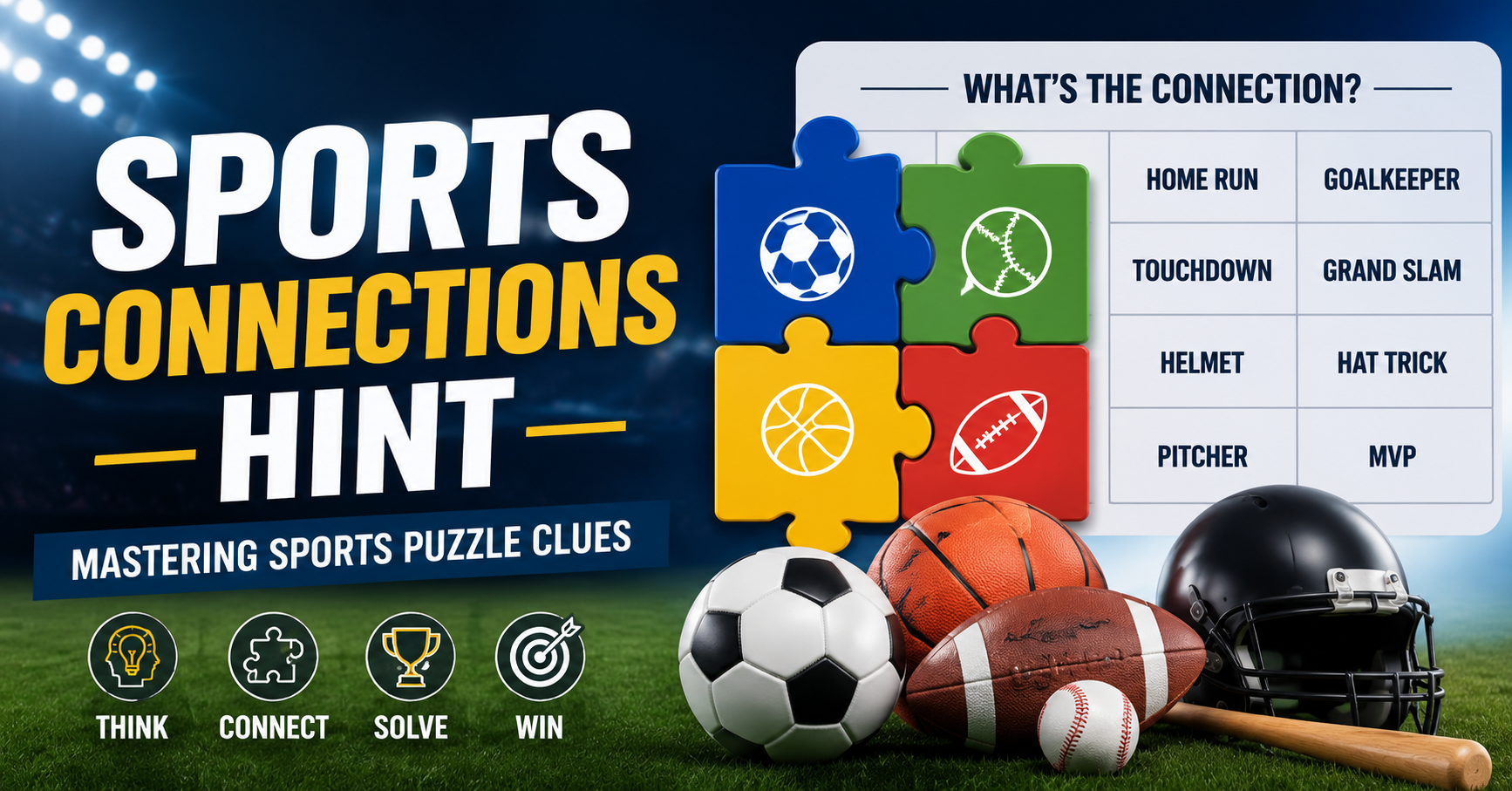
Sports-themed puzzle games have become increasingly popular among fans who enjoy testing both their athletic knowledge and problem-solving skills. One term that often appears in these games is sports connections hint. Whether you’re playing a daily connections puzzle, a trivia challenge, or a word association game, understanding sports connections can help you solve clues faster and improve your overall performance.
Sports puzzles are appealing because they combine entertainment with knowledge. They challenge players to recognize patterns, identify relationships, and recall facts from various sports. However, some clues can be surprisingly difficult, especially when multiple sports, athletes, teams, or terms seem connected.
In this guide, you’ll learn what sports connections hints are, how they work, common categories they use, and practical strategies to solve them more efficiently. Whether you’re a beginner or an experienced puzzle enthusiast, these tips can help sharpen your skills and make puzzle-solving more enjoyable.
What Is a Sports Connections Hint?
A sports connections hint is a clue that helps players identify a relationship between multiple sports-related words, names, or concepts. The goal is usually to group related items together based on a common theme.
For example, a puzzle may present the following words:
- Home Run
- Grand Slam
- Touchdown
- Hat Trick
At first glance, these terms seem unrelated. However, each represents a significant scoring achievement in a specific sport.
The connection may involve:
- Sports terminology
- Athlete names
- Team names
- Championships
- Equipment
- Positions
- Records
- Sporting events
The challenge lies in identifying the exact relationship that links the clues together.
Why Sports Connections Puzzles Are Popular
Sports connections puzzles appeal to a broad audience because they blend knowledge with critical thinking. Instead of simply recalling facts, players must identify patterns and relationships.
Several factors contribute to their popularity:
- They reward sports knowledge from multiple disciplines.
- They improve memory and analytical thinking.
- They create a fun challenge for casual and dedicated sports fans.
- They encourage learning about unfamiliar sports and athletes.
Many puzzle enthusiasts enjoy the satisfaction of discovering a hidden connection that wasn’t immediately obvious.
Common Types of Sports Connections
Understanding the most common categories can make solving sports connections hints much easier.
Athlete-Based Connections
One of the most common puzzle categories involves grouping famous athletes together.
Examples include:
- Olympic gold medalists
- Tennis champions
- Soccer legends
- Hall of Fame players
A puzzle might include names such as Serena Williams, Rafael Nadal, Novak Djokovic, and Roger Federer. The connection could be Grand Slam champions or elite tennis players.
Recognizing notable athletes across different sports can significantly improve your puzzle-solving abilities.
Team-Based Connections
Many sports puzzles focus on professional or national teams.
For example:
- Yankees
- Dodgers
- Red Sox
- Cubs
These all belong to Major League Baseball.
Sometimes the challenge becomes more difficult when team names overlap with common words or geographical locations.
Sports Equipment Connections
Equipment-related clues are another common category.
Examples might include:
- Bat
- Helmet
- Glove
- Baseball
The connection is obvious for baseball fans, but some puzzles intentionally mix equipment from multiple sports to create confusion.
Learning the basic equipment used in major sports can help you identify these relationships quickly.
Championship and Tournament Connections
Many sports connections hints revolve around major competitions.
Examples include:
- Wimbledon
- Masters
- Super Bowl
- World Cup
The common thread may be prestigious sporting events.
These puzzles often require broad sports knowledge across multiple disciplines.
Position and Role Connections
Player positions frequently appear in sports-themed puzzles.
Examples include:
- Quarterback
- Goalkeeper
- Pitcher
- Point Guard
The connection may be that each is a key position in a different sport.
Recognizing sports roles can help narrow down possible answers.
How to Solve Sports Connections Hints Effectively
Solving sports puzzles isn’t only about knowing sports facts. Strategy also plays an important role.
Look for Obvious Groups First
Start by identifying clues that clearly belong together.
For example:
- Basketball
- Football
- Baseball
- Soccer
These are all major sports categories.
Finding easy connections first reduces the number of remaining possibilities and simplifies the puzzle.
Consider Multiple Meanings
Many sports terms have meanings outside sports.
For example:
- Draft
- Pitch
- Match
- Club
Each can be used in everyday language as well as sporting contexts.
If a connection seems unclear, consider alternative meanings before making a final decision.
Focus on Specific Sports
Try grouping clues according to their sport.
For instance:
Basketball Terms
- Dunk
- Rebound
- Assist
- Layup
Baseball Terms
- Strikeout
- Home Run
- Pitcher
- Inning
Breaking clues into sport-specific categories often reveals hidden relationships.
Use Process of Elimination
If you’re unsure about a clue, temporarily set it aside and focus on the remaining words.
As more groups become clear, the difficult clues often become easier to place.
This approach reduces guesswork and improves accuracy.
Real-World Example of a Sports Connections Puzzle
Imagine you’re presented with these eight words:
- Helmet
- Bat
- Goalkeeper
- Pitcher
- Touchdown
- Home Run
- Glove
- Catcher
At first glance, there seem to be multiple possible connections.
After analysis, you might identify:
Baseball Group
- Bat
- Glove
- Pitcher
- Catcher
Remaining Sports Terms
- Helmet
- Goalkeeper
- Touchdown
- Home Run
Further examination may reveal a secondary connection involving sports equipment and scoring terms.
This example demonstrates why sports connections puzzles require both knowledge and logical thinking.
Benefits of Solving Sports Connections Puzzles
Beyond entertainment, these puzzles offer several cognitive benefits.
Improved Memory
Regular puzzle-solving strengthens memory recall by encouraging players to retrieve sports facts and terminology.
Enhanced Pattern Recognition
Connections games train the brain to identify relationships between seemingly unrelated items.
Expanded Sports Knowledge
Players often learn new athletes, teams, events, and terminology while solving puzzles.
Better Problem-Solving Skills
The process of testing theories and eliminating incorrect possibilities helps develop analytical thinking.
These skills can be useful in many areas beyond sports puzzles.
Pros and Cons of Sports Connections Puzzles
| Pros | Cons |
|---|---|
| Improves sports knowledge | Can be difficult for beginners |
| Enhances memory and critical thinking | Some clues may be overly ambiguous |
| Provides fun daily mental exercise | Requires familiarity with multiple sports |
| Encourages pattern recognition | Certain puzzles may rely on niche knowledge |
| Suitable for all age groups | Incorrect assumptions can be misleading |
Common Mistakes Players Make
Many players struggle not because they lack knowledge, but because they approach puzzles incorrectly.
Rushing to Conclusions
A clue that appears obvious may belong to a different category entirely.
Taking time to evaluate all possibilities often leads to better results.
Ignoring Less Popular Sports
Many puzzles include references to sports beyond football, basketball, or baseball.
Knowledge of tennis, golf, hockey, cricket, and Olympic events can be valuable.
Focusing on Individual Words
Sometimes players analyze clues separately rather than looking at the entire set.
Connections puzzles are designed around relationships, not isolated terms.
Considering the full picture often reveals hidden patterns.
Frequently Asked Questions About Sports Connections Hints
What does a sports connections hint mean?
A sports connections hint provides guidance for identifying a common relationship between sports-related words, athletes, teams, events, or concepts in a puzzle.
Are sports connections puzzles only for sports fans?
No. While sports knowledge helps, logical thinking and pattern recognition are often just as important.
How can I improve at sports connections games?
Practice regularly, follow different sports, learn common sports terminology, and use elimination strategies when solving puzzles.
Why are some sports clues difficult?
Puzzle creators intentionally include misleading or overlapping terms to make challenges more engaging and rewarding.
Do sports connections puzzles improve brain function?
Research on puzzles and cognitive activities suggests they can support memory, concentration, and problem-solving skills when practiced regularly.
Future of Sports Connections Games
The popularity of word puzzles and daily challenge games continues to grow. Sports-themed variations are becoming increasingly sophisticated, incorporating historical events, advanced statistics, player achievements, and cross-sport comparisons.
Digital platforms have made these games more accessible than ever. Players can now compete with friends, track their progress, and solve new challenges every day.
As sports data becomes more widely available, future puzzles may incorporate deeper levels of analysis, making them even more engaging for fans and puzzle enthusiasts alike.
Conclusion
Understanding a sports connections hint is about more than simply knowing sports facts. Success comes from recognizing patterns, understanding relationships, and applying logical thinking. From athlete groups and team names to equipment, tournaments, and scoring terms, sports connections puzzles challenge players to think creatively while expanding their sports knowledge.
Whether you’re solving a daily puzzle for fun or looking to sharpen your analytical skills, learning the common types of sports connections can significantly improve your performance. The more sports terminology and history you learn, the easier it becomes to identify hidden relationships and solve even the trickiest clues.
Keep practicing, stay curious, and explore different sports. Over time, you’ll become faster, more accurate, and more confident when tackling sports connections puzzles.