
Introduction: Understanding Your AP Chemistry Score Before Results Day
The AP Chemistry exam is one of the most challenging Advanced Placement tests because it requires strong knowledge of concepts, calculations, laboratory skills, and scientific reasoning. After taking the exam, many students wonder: “What score will I probably get?” A Chem AP Score Calculator can help estimate your possible AP score before official results are released.
An AP Chemistry score calculator uses your estimated performance on multiple-choice questions and free-response questions (FRQs) to predict whether you may earn a score of 1, 2, 3, 4, or 5. While it cannot provide an official result, it gives students a helpful idea of where they stand.
Understanding your estimated score can reduce uncertainty and help you evaluate your preparation. Whether you are aiming for college credit, placement advantages, or simply personal achievement, knowing how AP Chemistry scoring works is an important part of the process.
What Is a Chem AP Score Calculator?
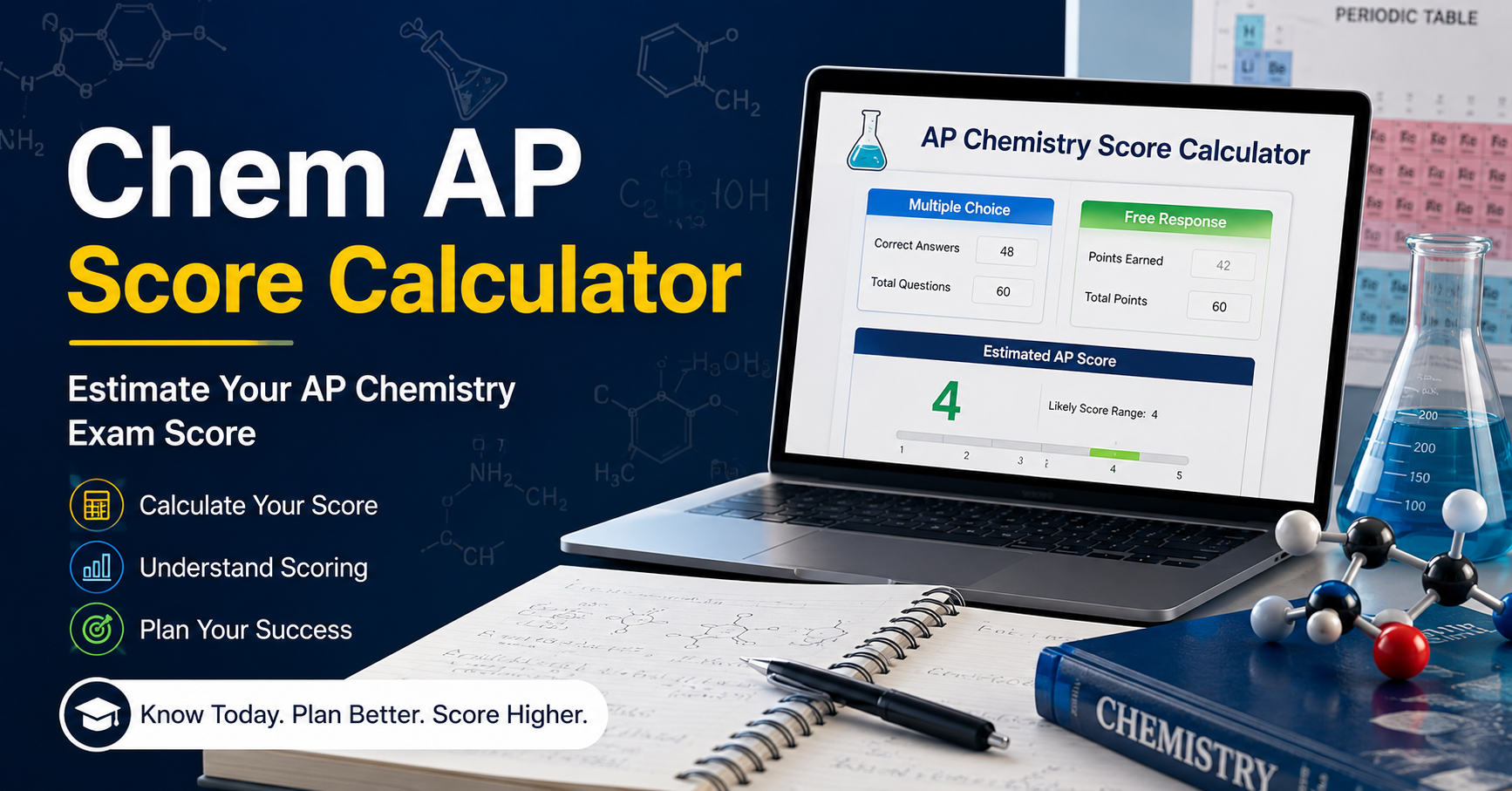
A Chem AP Score Calculator is an online tool designed to estimate your final AP Chemistry exam score based on your expected performance. It converts your raw points from different exam sections into an approximate AP score using scoring methods similar to those used by the College Board.
The AP Chemistry exam does not simply count the number of correct answers. Instead, your performance is converted into a scaled score. A calculator helps students understand how their raw score might translate into the final AP score scale.
For example, if you estimate that you answered most multiple-choice questions correctly and earned strong points on free-response questions, the calculator may predict that you are likely within the range of a 4 or 5.
However, students should remember that score calculators provide estimates only. The exact conversion changes from year to year depending on exam difficulty and official scoring guidelines.
How Does the AP Chemistry Scoring System Work?
The AP Chemistry exam has two main sections:
Multiple-Choice Section
The multiple-choice section tests your understanding of chemistry concepts, equations, data analysis, and scientific practices. It includes questions that require both memorization and problem-solving skills.
Students receive points for correct answers. Incorrect answers do not reduce your score, so attempting every question is usually recommended.
Free-Response Section (FRQ)
The free-response section requires students to explain their reasoning, solve calculations, analyze experiments, and interpret scientific information.
This section is divided into different question types, including:
- Long free-response questions that require detailed explanations and calculations.
- Short free-response questions that test specific chemistry skills.
Many students underestimate the importance of FRQs. Even if you do not complete every calculation perfectly, showing correct reasoning and proper steps can earn partial credit.
Why Use a Chem AP Score Calculator?
A score calculator can be useful for several reasons. First, it gives students a realistic estimate of their performance. After spending months preparing, many students want to know whether their current knowledge is enough for their target score.
Second, calculators help identify strengths and weaknesses. If your estimated score is lower than expected, you can focus on improving specific areas such as equilibrium, thermodynamics, kinetics, or laboratory concepts.
Students often use these calculators after practice exams. For example, if you complete a full AP Chemistry practice test and calculate your estimated score, you can decide whether you need more review before the actual exam.
How to Use a Chem AP Score Calculator Correctly
Using an AP Chemistry score calculator is simple, but accuracy depends on your input.
Follow these general steps:
- Enter your estimated number of correct multiple-choice answers.
- Add your expected points from the free-response section.
- Review the estimated AP score range.
- Compare your results with your target score.
For the best estimate, avoid guessing your performance too optimistically. Review your practice exam carefully and count only answers you are confident about.
A realistic estimate gives you more useful information than an overly positive prediction.
Example of AP Chemistry Score Estimation
Imagine a student completes a practice AP Chemistry exam and estimates the following:
- Strong performance in multiple-choice questions.
- Partial credit earned on most FRQs.
- Some mistakes in calculation-heavy topics.
The calculator may show that the student is likely around a 3 or 4.
This result does not mean the student will receive that exact score. Instead, it shows a possible range based on current performance.
If the student wants to move from a 3 to a 5, they can focus on improving weak topics and practicing more free-response questions.
Chem AP Score Calculator Pros and Cons
| Pros | Cons |
|---|---|
| Helps estimate your possible AP Chemistry score | Does not provide an official score |
| Shows whether your preparation level matches your goal | Score predictions may vary between calculators |
| Helps identify areas that need improvement | Depends on accurate self-estimation |
| Useful for practice exams and study planning | Cannot replace real exam experience |
Factors That Affect Your AP Chemistry Score
Several factors influence your final AP Chemistry score. The calculator provides an estimate, but the actual result depends on official scoring methods.
Exam Difficulty
Every AP Chemistry exam is different. Some years may have more difficult questions, while others may feel easier. The scoring process considers exam difficulty when converting raw points into final scores.
Accuracy of Your Estimate
A calculator is only as accurate as the information you provide. If you overestimate your answers, the predicted score may be higher than your actual result.
Understanding Chemistry Concepts
AP Chemistry requires more than memorizing formulas. Students need to understand relationships between concepts.
Important areas include:
- Atomic structure and periodic trends.
- Chemical reactions and stoichiometry.
- Thermodynamics and energy changes.
- Equilibrium and acids and bases.
- Electrochemistry.
- Laboratory analysis.
Strong conceptual understanding usually leads to better performance across both exam sections.
Common Mistakes Students Make When Using Score Calculators
Many students misunderstand what score calculators can do. The biggest mistake is treating an estimate as a guaranteed result.
A predicted score should be viewed as a guide, not a final answer. If a calculator predicts a 4, you should continue preparing if your goal is a 5.
Another common mistake is ignoring free-response practice. Some students focus only on multiple-choice questions because they seem easier to measure. However, FRQs can significantly affect your final score.
Frequently Asked Questions About Chem AP Score Calculators
Is a Chem AP Score Calculator Accurate?
A Chem AP Score Calculator can provide a reasonable estimate, but it is not guaranteed to match your official AP score. The final score depends on the yearly scoring process used by the College Board.
What AP Chemistry Score Should I Aim For?
Many students aim for a 4 or 5 because these scores may qualify for college credit at many institutions. However, the best target depends on your personal goals and the requirements of your preferred colleges.
Can a Score Calculator Predict a 5 on AP Chemistry?
Yes, a calculator can estimate whether your performance is within a possible 5-score range. However, achieving a 5 requires strong performance across both multiple-choice and free-response sections.
When Should I Use an AP Chemistry Score Calculator?
The best time to use one is after completing practice exams or reviewing your expected exam performance. It can help you measure progress and adjust your study plan.
Tips to Improve Your AP Chemistry Score
If your estimated score is lower than your goal, improvement is possible with focused preparation.
Practice solving chemistry problems regularly instead of only reading notes. AP Chemistry rewards students who can apply concepts in unfamiliar situations.
Also, spend time reviewing mistakes. Understanding why you made an error is often more valuable than simply checking the correct answer.
Free-response practice is especially important because it teaches you how to explain scientific reasoning clearly.
Conclusion: Use Score Estimates as a Study Guide
A Chem AP Score Calculator is a helpful resource for students who want to estimate their AP Chemistry performance. It can provide insight into your current preparation level, highlight areas for improvement, and help you set realistic goals.
Remember that calculators are only prediction tools. Your final AP score depends on your actual exam performance and official scoring standards.
Use score estimates as motivation to continue improving. With consistent practice, concept review, and effective exam strategies, you can increase your chances of achieving your desired AP Chemistry score.