
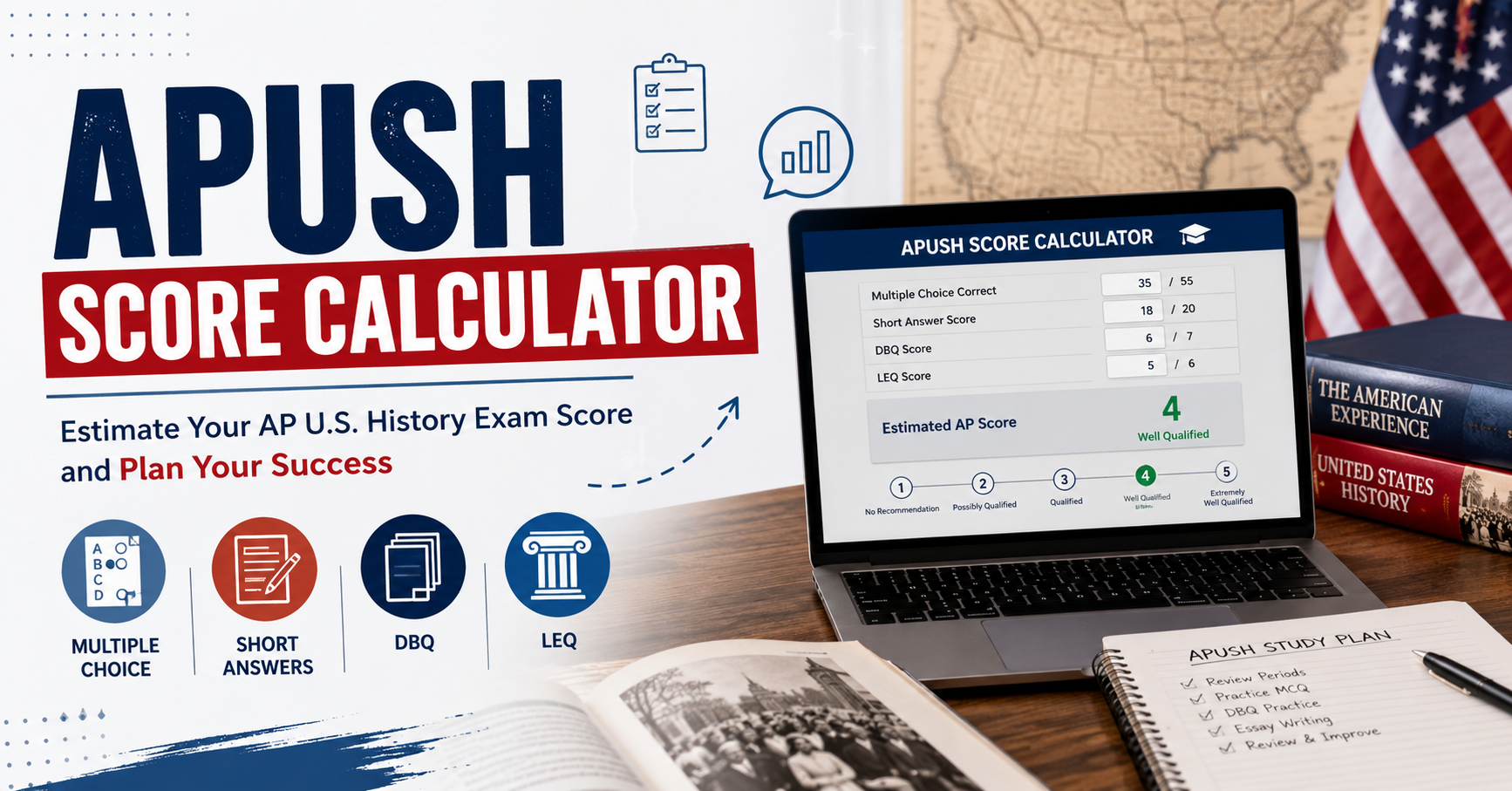

The AP U.S. History exam can feel challenging because it tests much more than simple memorization. Students must analyze historical documents, understand major events, write clear arguments, and connect ideas across different time periods. After taking practice tests or completing exam sections, many students want to know: “What score will I likely get on the APUSH exam?”
An APUSH score calculator helps students estimate their possible AP exam score by converting practice test results into an approximate AP score range. While it cannot guarantee your final result, it provides a useful prediction and helps you understand where you stand before the official exam.
Whether you are preparing for your first APUSH test or reviewing your performance after a practice exam, understanding how score calculations work can help you create a better study plan.
What Is an APUSH Score Calculator?
An APUSH score calculator is an online tool that estimates your final AP U.S. History exam score based on your performance in different exam sections. The APUSH exam uses a combination of multiple-choice questions, short-answer questions, document-based questions (DBQ), and long essay questions (LEQ).
Because the AP exam is scored on a scale from 1 to 5, students often use calculators to estimate whether their current performance is close to earning a passing score or a higher score.
For example, a student may enter:
- Number of multiple-choice questions answered correctly
- Short-answer question performance
- DBQ writing score
- LEQ writing score
The calculator then provides an estimated AP score, usually ranging from a possible 1 to 5.
It is important to remember that AP score calculators are only prediction tools. The official scoring process involves statistical analysis by the College Board, and the exact score boundaries can change each year.
How Does the APUSH Score Calculator Work?
The APUSH exam is divided into several sections, and each section contributes differently to your final score.
The current AP U.S. History exam structure includes:
- Section I: Multiple Choice and Short Answer Questions
- Section II: Free Response Questions, including DBQ and LEQ
Each part has a different weight, meaning some sections have more influence on your final score than others.
A typical APUSH score calculator follows a process like this:
First, it converts your raw performance into weighted points. For example, answering more multiple-choice questions correctly increases your total score, while stronger DBQ and LEQ responses add additional points.
Next, the calculator compares your estimated total points with previous AP score ranges. Based on this comparison, it predicts whether your performance is closer to a 3, 4, or 5.
For example:
A student who performs well on multiple-choice questions but struggles with essays may receive a lower estimate than a student with balanced performance across all sections.
Understanding APUSH Score Ranges
AP scores are reported from 1 to 5:
- 5 – Extremely well qualified
- 4 – Well qualified
- 3 – Qualified
- 2 – Possibly qualified
- 1 – No recommendation
Most colleges consider a score of 3 or higher as passing, although individual college policies vary.
A student aiming for a competitive score usually focuses on earning a 4 or 5. However, a strong APUSH score depends on several factors, including preparation time, writing ability, historical knowledge, and exam strategy.
Why Students Use APUSH Score Calculators
Many students use APUSH score calculators because they want a realistic idea of their current progress. Instead of guessing, they can measure their performance and identify areas that need improvement.
An APUSH calculator can help students:
- Track improvement during exam preparation
- Understand how practice test results translate into AP scores
- Identify weak areas such as essays or historical periods
- Set realistic study goals before exam day
For example, if a student receives an estimated score of 2 after a practice test, they can focus on improving content knowledge and writing skills. A student scoring near a 4 may focus more on refining essay techniques and avoiding small mistakes.
APUSH Exam Sections Explained
Multiple Choice Questions
The multiple-choice section tests your understanding of U.S. history from approximately 1491 to the present. Questions often include historical documents, images, maps, and political cartoons.
Success in this section requires more than remembering dates. Students must understand causes, effects, historical trends, and connections between events.
A strong multiple-choice score can significantly improve your estimated APUSH score.
Short Answer Questions
Short-answer questions require students to respond to historical prompts using evidence and explanations.
These questions are shorter than essays but still require clear historical reasoning.
Students often lose points because they provide facts without explaining how those facts support their answer.
Document-Based Question (DBQ)
The DBQ is one of the most important parts of the APUSH exam. Students analyze historical documents and write an argument using evidence.
A strong DBQ response usually includes:
- A clear thesis statement
- Evidence from provided documents
- Historical context
- Explanation of how evidence supports the argument
Practicing DBQs regularly can have a major impact on your estimated score.
Long Essay Question (LEQ)
The LEQ requires students to create an argument about a historical topic without using provided documents.
Students must demonstrate historical knowledge and organize their ideas clearly.
A well-written LEQ can help increase your overall APUSH score estimate.
APUSH Score Calculator Pros and Cons
| Pros | Cons |
|---|---|
| Helps estimate your possible AP score | Cannot predict the exact official score |
| Shows areas where improvement is needed | Different calculators may use different formulas |
| Helps create realistic study goals | Score boundaries change from year to year |
| Provides motivation during preparation | Does not replace official College Board scoring |
How Accurate Are APUSH Score Calculators?
The accuracy of an APUSH score calculator depends on the formula it uses. Some calculators are based on previous AP scoring patterns, while others use simplified estimates.
They can provide a helpful general idea, but they should not be treated as an official prediction.
For example, if your calculator estimates a 4, you may still receive a 3 or 5 depending on the difficulty of that year’s exam and the official score conversion process.
The best way to use a calculator is as a progress measurement tool rather than a final prediction.
Tips to Improve Your APUSH Score
If your estimated score is lower than your goal, there are several ways to improve.
Start by reviewing the historical periods where you lose the most points. APUSH covers many topics, including colonization, the American Revolution, the Civil War, industrialization, world wars, and modern America.
Practice writing essays under timed conditions because many students understand history but struggle to organize their answers quickly.
Also, review official-style questions. The more familiar you become with APUSH question formats, the easier it becomes to recognize what exam questions are asking.
Common Questions About APUSH Score Calculators
Is an APUSH score calculator accurate?
An APUSH score calculator can provide a reasonable estimate, but it cannot guarantee your final AP score. The official score depends on yearly scoring standards.
What score do I need to pass APUSH?
Generally, a score of 3 or higher is considered passing. However, colleges decide how they award credit for AP scores.
Can I get a 5 on APUSH?
Yes. Students who understand historical concepts, practice writing strong essays, and complete regular review can achieve a top score.
Should I use an APUSH score calculator before the exam?
Yes, it can be useful for checking your progress and identifying weaknesses. However, continue preparing instead of relying only on the estimate.
How to Use an APUSH Score Calculator Effectively
The best approach is to use the calculator several times during your preparation.
Take a practice exam, enter your results, and review the estimated score. Then focus your study sessions on improving your weakest areas.
For example, if your multiple-choice performance is strong but your DBQ score is low, spend more time practicing document analysis and historical argument writing.
A calculator becomes more valuable when combined with consistent practice and honest self-evaluation.
Final Thoughts on APUSH Score Calculators
An APUSH score calculator is a helpful resource for students preparing for the AP U.S. History exam. It allows you to estimate your performance, measure progress, and create a smarter study strategy.
Although it cannot predict your exact official score, it provides useful guidance and helps you understand how different exam sections affect your results.
Use it as a learning tool, continue practicing important skills, and focus on improving both your historical knowledge and writing abilities. With consistent preparation and the right strategy, you can increase your chances of achieving your desired APUSH score.