

Introduction: Two Ways to Play the Same Game
There are few sports in which the rules can affect the whole spirit of the game as much as golf — even if everything else remains the same, from the course and clubs to the players. Discuss the merits of match play or stroke play with any golfer and you are sure to have some spirited discussion.
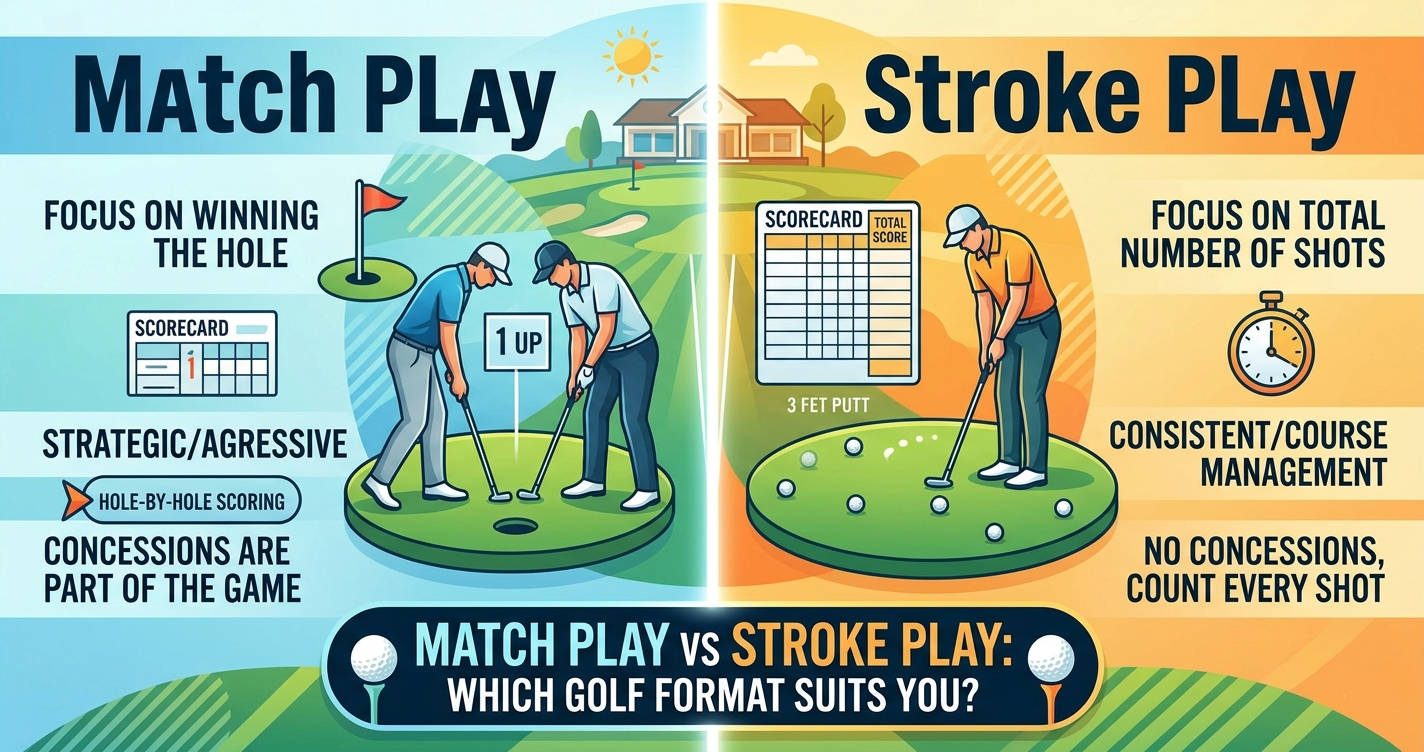
All parts of the golf course, swings and general rules will be the same in both formats. But how to win? Completely different. It’s that difference that becomes a factor in your game, your attitude and even the pressure you feel on a three-foot putt.
This golf guide will help you understand the different types of golf (Match Play vs Stroke Play), whether you’re new to the game or an avid golfer seeking a fresh understanding of the possibilities.
What Is Stroke Play?
The most popular format in golf is stroke play, which is likely the first format you’ve heard of. It’s quite easy to understand: All shots are meaningful. At the end of the round (or the tournament) the one with the least strokes wins.
The format is identical to that for the biggest golfing competitions. The Masters, the Open Championship, the U.S. Open and others use stroke play to determine the winners. All shots are equal. If you double bogey on No. 3 then you not only have a bogey on No. 3, you have the next two strokes on your total score card for the rest of the round.
It’s what makes them challenging to play. No second chances on the next hole. A bad hole follows you; That’s why course management and consistency is so important in stroke-play; if you are going to play, you cannot blow up holes.
For golfers who play for fun, the stroke play is the method used to determine handicap. I suppose if you are keeping score and trying to raise your index, you will be doing it during round play.
What Is Match Play?
Match play changes the scoring altogether. You don’t play all the shots, you compete hole by hole. If you win more holes then you win the match! It’s that straightforward.
If you shoot four par 4s and your opponent shoots five, you win that hole. You take a “one-up” in the match. If both shoot four shots, the hole is divided in half — it is a ‘tie’ — and neither player takes any advantage. The game is ended when one player is ahead of the other in number of holes by the number of holes left. “dormie” and “3&2” or “4&3” are simply the results of the games where the winning player was mathematically impossible to come up with.
Match play has a rich history in golf. The Ryder Cup is one of, if not the most emotional tournament in golf, and it’s completely match played. It builds drama, ebbs and flows and real head-to-head tension that stroke play can’t replicate.
This is one of the most significant strategic differences: In match play, a poor hole can be conceded and forgotten. If you have virtually no chance of getting out of this bunker to win the hole, you may pick up your ball, concede the hole to your opponent and leave the bunker with your mind intact. In stroke play, that’s not an option.
Key Differences Between Match Play and Stroke Play
Knowing the essential distinctions will help you grasp the reasons behind the differences between players’ play styles in each game.
- The scoring system: In stroke play, the number of strokes that you take is the most important thing. Only the successful hole is important in match play – the score on the hole is not!
- Strategy: When playing stroke play, playing conservatively can be advantageous. Big numbers are to be avoided, as there is a possibility to get them wrong. On the particular hole where a shot is made in match play, it may be necessary to take the high-risk shot if you are down and need to do something good.
- Mental approach: If you have a triple bogey in stroke play, it can throw you off your game. In match play, you lose only one hole. A lot of golfers prefer match play for just this reason.
- Concessions: In match play, concede a putt to the other player (the other player gets the hole or the next putt). This is a tactic and sportsmanship aspect which is simply not available in the stroke play.
Which Format Is Better for Beginners?
For those who are just getting into the game, match play may be the more palatable format. It can be demoralizing for newer players to strive to sum each stroke over 18 holes. In stroke play, a couple of poor holes can make the entire round seem like a waste. Momentum keeps things interesting in match play as you can be 3 down and then 4 up.
However, it is really stroke play that will help improve you quicker. Every shot is a shot, so that makes it the only emphasis on every 18 holes. No one can jog along a path that they have “lost. This is why most coaches have recommended that younger golfers have stroke play as a regular course practice that teaches them consistency and discipline.
The truth is there are pros and cons to both formats even for beginners. Track progress and practice game using stroke play. When you’re looking for a friendly competitive match that keeps the game intriguing throughout, match play is the answer.
Match Play vs Stroke Play in Professional Golf
Professionally they share the same arena, with stroke play being the predominant format in the major tours. The four majors (Masters, U.S. Open, The Open Championship, and the PGA Championship) are all stroke play, played over four rounds.
From the highest levels of match play, there is much to offer. The WGC-Dell Technologies Match Play is one of the most popular on the PGA Tour. For that reason alone, both match play events (Ryder Cup and Presidents Cup) are rich in the memorable moments of pro golf — particularly come-back shots and clutch moments in the event of head-to-head pressure.
For some reason, a lot of experts have said that match play takes a mental adjustment. Dominating a stroke play event doesn’t necessarily lead to success in match play and the strategy and psychological aspects of the two are indeed quite different.
A Quick Word on Other Golf Formats
It is important to note that there are other options besides match play and stroke play. There are other formats of play, such as Stableford scoring, fourball, foursomes and scramble that are in use and popular on club level around the world. There are two basic forms of play: match play and stroke play and most of the other forms are variations or hybrids of these two.
Conclusion: Different Games, Same Course
Both match play and stroke play offer something for all golfers. The stroke play format is for the patient, consistent, and can be played through and through without cracking. Match play demands flexibility, toughness and courage to go one shot to shot at large against one player and on every hole.
It’s not right or wrong which you use, they are both special experiences. As a golfer, the most beneficial thing you can do is play regularly. You will see that there are some things that each format will highlight about your game and that together, they make you a more complete player.
If you want to learn more, read about how the Ryder Cup features match play format in the singles, foursomes and fourball sessions, which is a great lesson on how format can add drama to the competition that stroke play cannot.